From supercycle to supply chain: Hyosung’s playbook for Australia’s transmission crunch
An interview with Jared Jun, Hyosung
What is driving Hyosung's approach to the transition?
For Hyosung Heavy Industries, the energy transition is not a passing industry theme — it is a generational responsibility. Our starting point is a clear conviction: electrification and clean-energy expansion are the most essential means of achieving carbon neutrality, and what ultimately enables them is the grid.
Hyosung has recently said the global power market is entering a "super-cycle" driven by AI and renewable expansion, and that Hyosung Heavy Industries must become "a game-changer that reshapes the grid." That conviction sets the tone for how we work in Australia.
We see the transition as solving three challenges at once: climate response, energy security, and economic competitiveness. These three goals stay in balance only if the underlying power infrastructure can carry them. BloombergNEF reports that global energy-transition investment hit a record US$2.3 trillion in 2025, and grids were the fastest-growing segment — a strong signal that the market has reached the same conclusion we have.
In Australia, we translate that view into concrete delivery. We are supplying phase-shifting transformers, power transformers and reactors into both the NSW and SA sections of Project EnergyConnect, and our ultrahigh-voltage transformers and other power equipment are also going into HumeLink, VNI West and other key NEM transmission-reinforcement projects. In early 2026 we signed our first Australian BESS contract — a 100 MW / 200 MWh battery system at Tangkam.

“the global transformer supply chain has become seriously tight”
With every major economy needing the same equipment at the same time, the global transformer supply chain has become seriously tight. Lead times for ultrahigh-voltage transformers have more than doubled from pre-Covid norms, and that is a direct constraint on Australia's transmission timetable. That is precisely why Hyosung has crossed AUD 10 billion in cumulative ultrahigh-voltage transformer production and is doubling capacity — because for us the transition isn't a slide; it is the work of getting the right transformers built and onto site, on time.
How do you see the reality of 2030 targets aligning with current delivery pathways?
There is a meaningful gap between ambition and delivery.
To stay on the Net Zero Scenario pathway, global investment would need to rise by about 125%, more than double current levels. Grid investment shows the largest gap of any sector. Australia sits inside that same pattern. AEMO's 2024 ISP calls for around 10,000 km of new transmission and roughly A$16 billion of investment to support an 82% renewable share by 2030. But major transmission projects have seen capital cost increases of more than 30%, delays of around three years, and post-review restructuring into staged delivery models. When transmission slips, generation queues, load connections and coal retirements slip with it.
Even so, I am not pessimistic. A well-defined gap tells us exactly where to concentrate resources. We see three levers to accelerate. First, supply-chain capacity — we are doubling transformer output to meet market demand. Second, standardised and modular solutions. Third, "bridge" technologies — STATCOM and BESS — that buy time where transmission reinforcement is slower than the queue.
The 2030 target is tight, not infeasible. But the centre of gravity now has to move from planning to building, from approvals to commissioning.
How might the transition create different outcomes for regions, technologies and customer classes?
The transition does not unfold uniformly. It moves at different speeds and in different shapes across regions, technologies and customer classes — and that unevenness is one of the most important things for policymakers and industry to manage carefully.
“capital is sensibly concentrating on no-regret assets”
92.5% of 2025 investment went into mature technologies — solar, wind, batteries, EVs and grids. Clean-hydrogen investment fell for a second consecutive year. CCS recovered modestly but remains small. That tells us capital is sensibly concentrating on no-regret assets, but it also signals that hard-to-electrify industrial sectors may have to wait longer than the 2030 narrative implies.
By customer class, data-centre capex has already passed half a trillion dollars a year and overtaken global solar investment. Hyperscalers and large industrial loads can pay a premium for reliability. Households and small businesses generally cannot. Hyosung designs around both ends of that spectrum: robust ultrahigh-voltage transmission and substation equipment for industrial and data-centre loads, and grid-stabilising assets — STATCOM and BESS — that protect supply quality for everyone connected downstream.
One additional point worth highlighting. The transformer shortage gets a lot of attention, but underneath it sits an even narrower bottleneck. Upstream components such as bushings and tap changers fall into this category. A six-month delay on a single tap changer can hold up the delivery of a 1,000 MVA transformer, and a bushing shortage can stop a substation from being commissioned.
The implication is that the procurement model itself has to change. First, utilities and developers need to plan core-component orders or capacity reservations significantly earlier than the project schedule, typically two to three years ahead, rather than treating procurement as a downstream activity. Second, the depth of information-sharing between OEMs and their component suppliers needs to step up. Hyosung is expanding multi-year framework agreements, rolling-forecast sharing, and capacity-reservation arrangements with key customers, so that demand and production capacity are aligned upstream rather than negotiated at the point of order. Third, strategic stocking and standardisation of critical small components should be built in at the design stage, not addressed only when something is already missing. Supply-chain resilience has to be examined end-to-end, not just at the headline equipment level, and this is no longer purely an engineering issue. It is a question of procurement strategy and the partnership model between developers, utilities, and OEMs.
What are some common misconceptions about the transition, and how do they compare with reality?
First, that "the transition is slow because we don't have enough renewables." The reality is the opposite. Generation is broadly on pace; what is not on pace is the grid and the load that has to absorb it. Most of the 2025 investment growth came from EVs, grids and storage, while renewable-energy investment actually fell. Australia's connection queue is the clearest evidence I can point to.
Second, that "the job is done once we add clean megawatts." In practice, more variable generation means more — not less — need for reactive-power compensation, voltage stabilisation and inertia. That is precisely why Hyosung is focused on STATCOM and on next-generation HVDC solutions.
Third, that "power equipment is old technology, so you can buy it when you need it." In reality, lead times for transformers, GIS and HVDC converters now run three to five years or more. Put differently, the moment you decide to place the order is effectively the moment you commit to your project's go-live date. There is simply no way to compress that timeline once it is set. Hyosung has passed 10 trillion won in cumulative ultrahigh-voltage transformer production and is doubling capacity to serve growing US demand, itself a signal that the market is finally pricing this reality in.
So: the true bottleneck is infrastructure, not generation. Time is not abundant. And the cleaner technologies are already commercial.
What about the transition keeps you up at night?
The first risk I see is that markets and customers with capital, grid access and workforce will pull ahead, while those without fall further behind. If that gap grows too wide, the social licence for the transition begins to crack.
“any single bottleneck stops the whole queue”
Second, supply chain. Transformers, HVDC equipment, subsea cables and substation sites are all constrained at the same time, and any single bottleneck stops the whole queue. Delivering a single phase-shifting transformer for EnergyConnect taught us that vividly - a roughly 900-kilometre, multi-state convoy. One piece of critical equipment running late can move an entire interconnector's commissioning date.
Third, people. There is a global shortage of linesmen, substation engineers and commissioning specialists. This is not just an Australian problem — it is a global one. We are expanding local hiring and skills transfer through Hyosung Heavy Industries Australia & New Zealand, but no single company or country can solve this alone.
Fourth, the moment when the "affordability" promise of the transition wobbles. If household bills spike too quickly, even strong climate policies retreat politically. That is why our work is not just about clean equipment, but about low-loss, high-efficiency, low-operating-cost equipment. That is the underlying logic of our investment in high-efficiency transformers and loss-minimising design.
And finally, time itself. 2030 still feels distant, but the moment you think in transformer lead times, it is already here.
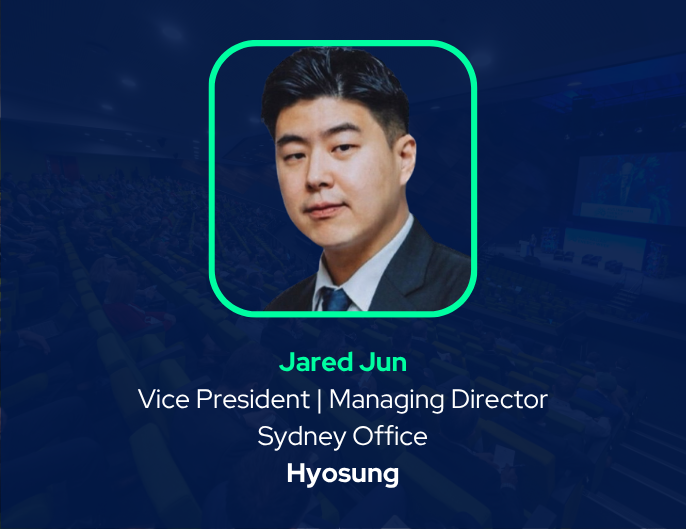
Based in Australia, Jared Jun is Vice President and the first Managing Director of Hyosung’s Australian operations.
Download brochure