Article:
Storage is booming - but is the revenue stack bankable long-term?

Australia’s battery buildout is rapidly becoming one of the hottest investment themes in the National Electricity Market (NEM).
One theme kept surfacing: storage is clearly essential, but the commercial model is evolving fast. FCAS has already faded as the dominant earnings source. Arbitrage is now doing the heavy lifting. And beyond that, policy design, contracting structures and the system’s need for longer-duration firming will determine which assets still stack up in five years’ time.
What will determine long-term financial viability?
The clearest consensus is that battery economics now live or die on revenue certainty.
“It has been interesting to see the primary financial returns from batteries transition from FCAS to energy arbitrage over the past few years,” Laura Jones, battery researcher at Australian National University says.
“FCAS was never a deep market”, and as more batteries enter the system, they are starting to reshape the very price events they were built to monetise.
That self-cannibalising dynamic is one of the sector’s defining tensions. Jones describes a “cat and mouse” game in which developers continually retune battery specifications to capture the next pocket of value, including longer-duration events as shorter spikes are increasingly damped by existing batteries.
Richard Hobbs, Partner, BCG puts it more bluntly: “Over the long term, the most important factor will be the shape of energy price spreads,” particularly across 2-, 4- and 8-hour durations. With arbitrage now the main revenue stream, future returns will be shaped by battery penetration, gas prices, renewable buildout and, above all, coal closures.
“Through to 2035, the timing of coal retirements may be the single biggest driver,” he says.
Damian Edwards, Business Unit Manager, Energy One also sees volatility as the core commercial input. “By far, the most critical factor is the stability of revenue streams,” he says, arguing that arbitrage and FCAS have historically underpinned battery projects, with newer virtual offtakes adding some revenue certainty. But arbitrage itself depends on one uncomfortable truth: “The very nature of battery storage’s ability to rapidly respond… will require a certain level of price volatility within a market to attract investment.”
For Stuart Hillen, Country Lead and Director of Development, ANZ, Eku Energy, the issue is not simply spread capture but capital formation.
“Like all large-scale infrastructure assets, we need the right pools of capital… to continue to be attracted to invest in the sector.”
Dan Nugent, Executive of Transition and Trading, EnergyAustralia takes the argument a step further. Today’s arbitrage may support 2–4 hour batteries, but that does not mean the market is rewarding the duration the system will eventually need.
Where are the biggest opportunities and risks in the revenue stack?
Arbitrage is the opportunity; merchant exposure is the risk.
Hobbs says the revenue mix has flipped in only a few years.
“Today, around 75–80% of revenues typically come from energy arbitrage and 20–25% from FCAS,” he says, versus the inverse five years ago.
That reflects how quickly FCAS prices softened as more batteries came online. In Hobbs’ view, the next opportunity is not just market participation, but smarter hedging.
“The biggest opportunity now lies in innovation around revenue de-risking and portfolio integration,” through tolling, OTC structures, cap products and other mechanisms. The biggest risk is clear: “merchant exposure for standalone batteries.”
Edwards is similarly sceptical of any strategy that still leans too heavily on FCAS. “We see many battery developers still looking to FCAS as a material revenue stream, overlooking the relative size of that market,” he says. With energy demand in the NEM sitting orders of magnitude above FCAS volumes, he argues the real opportunity remains arbitrage, especially in volatile regions. But saturation is coming.
Nugent identifies another opportunity often missed in pure market discussions. Existing thermal sites and community battery locations can unlock lower-cost deployment and stronger local value propositions. “The greatest risk is cannibalisation,” he warns.
Jones adds a longer-range uncertainty that could prove just as disruptive: distributed storage. “Vehicle-to-grid, for example, theoretically could meet pretty much all of Australia’s energy storage needs,” she says. If price-responsive V2G and virtual power plants scale meaningfully, grid-scale batteries may need to shift toward system strength, emergency management and extreme system conditions rather than pure arbitrage.
What would give investors more confidence?
All five interviewees point to the same trio: clearer long-term revenue frameworks, better valuation of system services, and faster connection processes.
Investors need predictability, transparent rulemaking, stable policy direction, and frameworks that recognise storage as essential energy infrastructure rather than an opportunistic add-on. Hillen argues the market needs to better procure services from grid-forming inverter plants rather than defaulting to more capital-intensive alternatives.
Edwards is explicit about what that means commercially: “Any policy or instrument that improves the bankability of storage revenue streams will have the greatest impact.” While the Capacity Investment Scheme has supported investment, the approaching end of the program in 2027 leaves uncertainty for developers planning pipelines over the next 10 to 15 years. He also points to grid connection as a critical bottleneck.
Many projects already rely on tolling or revenue-swap arrangements to reduce uncertainty, but Jones says unresolved end-of-life risks remain. “The future will remain a bit uncertain,” she says, even if reforms narrow the tenor gap identified in the wholesale market settings review. Western Australia’s capacity market is an example of how duration requirements can shape the asset mix.
Nugent argues the system now needs three things: a well-designed, enduring capacity mechanism beyond today’s CIS settings; genuinely technology-neutral market design that rewards services such as inertia and system strength; and faster connection approvals.
What role will storage play over the next five years?
On reliability, these experts broadly agree that batteries will become indispensable — but not sufficient on their own.
“Over the next five years, batteries will be the workhorse technology for meeting short-duration system needs,” says Hobbs. They will absorb excess solar, firm morning and evening peaks, and provide critical system services. The winter reliability challenge will require a broader mix, including gas, pumped hydro and wind.
Jones expects a more operationally complex battery fleet, where state of charge matters more to dispatch and scarcity management. “A battery-operated grid will be different to today,” she says, and may require new operating metrics and even batteries built specifically for system integrity.
Stuart Hillen says storage is moving “from being a marginal FCAS provider to a core component of a stable, renewable-dominated grid.” And Nugent captures the balancing act ahead most directly: “Storage will move from market participant to system cornerstone,” he says. But the transition must stay realistic; storage cannot do everything alone.
That may be the clearest message for Australian Energy Week delegates. Long-term bankability will depend on whether markets and policy evolve quickly enough to reward not just fast response, but the deeper reliability services the grid increasingly needs.
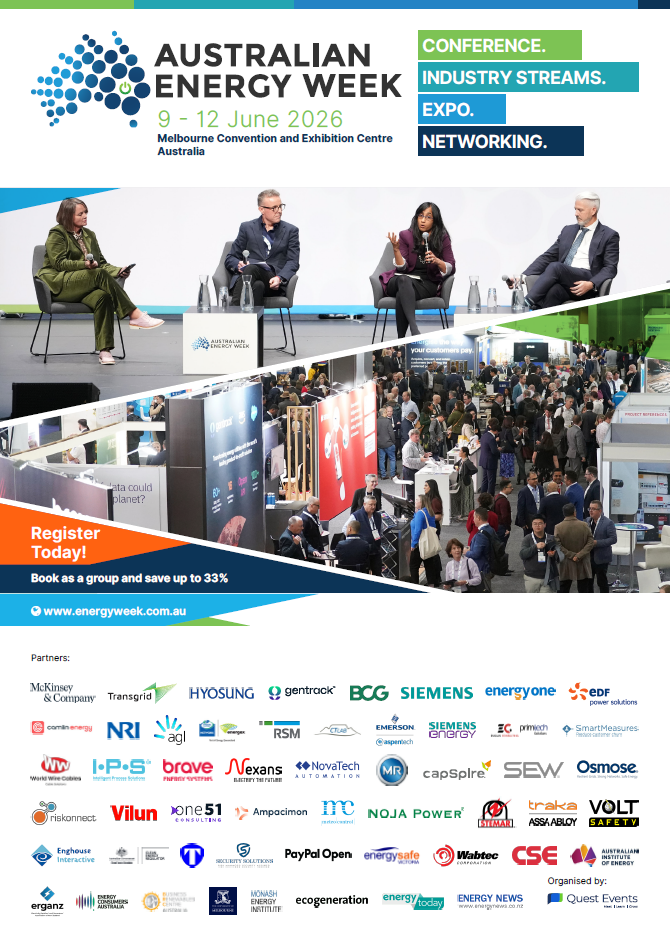
Join the conversation with Laura Jones, Richard Hobbs, Damian Edwards, Stuart Hillen, Dan Nugent and a host of other energy experts at Australian Energy Week.
Download brochure