By Rose Mary Petrass
Transmission build speed, connection queues and social licence are now critical path issues for Australia’s energy transition. As renewable generation accelerates and households electrify, the question is no longer whether the grid needs to change, but whether it can change fast enough.
Ahead of Australian Energy Week, we asked six industry leaders where they see the greatest risks to grid readiness — and what decisions must be made now to stop the grid from becoming the limiting factor in the transition. Their answers reveal broad agreement on one issue: the problem is no longer purely technical. Trust, regulation and smarter use of existing infrastructure may matter just as much as new transmission lines.

“Trust, regulation and smarter use of existing infrastructure may matter
just as much as new transmission lines.”
What breaks first: transmission delays, connection bottlenecks or social licence?
For Gloria Chan, Executive Director at the CEFC, timely delivery of transmission remains fundamental because it underpins renewable energy connections and ultimately determines costs for consumers.
She points to Clean Energy Investor Group analysis showing delays in transmission could cost the National Electricity Market up to $40 billion per year of delay. Existing projects such as Project EnergyConnect, HumeLink, Central West Orana REZ and Marinus Link are already underway, but she says the real challenge is getting future major projects to final investment decision quickly.
“Facilitating timely delivery of transmission projects is critical to both accelerating connection of renewable energy projects and reducing the overall cost to the energy system,” she says.
Social licence, approvals and landholder engagement are critical, alongside supply chain management and early procurement decisions.
For IBM’s Ravi Mandalika, connection bottlenecks are a risk that is less visible but more immediately constraining than others:
“Across the NEM, there is no shortage of generation or storage projects ready to proceed. The constraint is getting them connected, studied, and integrated into an already stressed system.”
Defining the biggest risk to transmission projects
For both Danielle Beinar from the AEMC and Stewart Bell from Powerlink Queensland, social licence is the single biggest risk.
Social licence is “the condition that determines whether anything else gets built,” Beinar says.
While often misunderstood as local opposition to individual projects, it is actually much broader.
Trust in how the transition is being delivered — particularly under cost-of-living pressure — now determines whether communities, consumers and institutions will support the pace and scale of change required.
“In the end, the grid will only move as fast as the community is willing to move with it.”
Bell agrees, arguing that the sector has focused too heavily on macro benefits and not enough on local value propositions such as jobs, resilience and business opportunities.
Powerlink’s research shows the biggest driver of trust is demonstrating how the benefits of development outweigh the impacts, while procedural fairness — responsiveness, transparency and follow-through — is equally important. Communities want to be heard and involved, not simply informed after decisions are made.
The overlooked bottleneck: distribution networks
While transmission often dominates the debate, Renate Vogt, from CitiPower, Powercor and United Energy says one of the most overlooked risks is distribution network readiness.
If local networks are not ready for increased winter demand, the issue will become power quality at street level.
“We are already hearing from customers that when voltages drop, their appliances do not work properly or they switch off completely, and their EVs do not charge.”
Calling for proactive regulatory frameworks, Vogt warns that if networks cannot support electrification when customers need it most, trust in the transition will break first.
“The solution is targeted, proactive investment in distribution networks so customers can charge, heat and power their homes safely and reliably as electrification accelerates.”
Could consumer energy resources reduce the need for more grid?
Eddie Thanavelil of SA Power Networks takes a different view, arguing the biggest risk is not fully leveraging consumer energy resources (CER).
“The current trajectory of the energy system relies largely on large-scale generation, storage and transmission and does not properly value or utilise the lowest cost sources of generation and storage we have.
“These resources can be hosted within the existing capacity of the distribution network and we don't need to necessarily expand the grid, we can fit more on what we already have.”
Without that shift, he warns, long transmission queues, higher costs and delayed commissioning will continue — despite cheaper and faster solutions already existing.
“distributed energy coordination should not be underestimated”
NEM regulatory specialist Jess Hunt agrees transmission build delays are the most immediate risk at the transmission level, but says distributed energy coordination should not be underestimated.
She warns congestion will grow as wind and solar increase, and without faster transmission build, developers may stop investing if the market no longer offers an attractive value proposition.
At the same time, managing millions of household assets in low-voltage networks creates its own trust and coordination challenge.
“Without a change in focus, connection readiness will continue to be an issue,” Hunt says.
What decision must be made in the next 12 months?
Across the board, the answer is better regulatory settings.
Hunt says the grid is already a limiting factor and rather than relying only on more transmission, Australia should focus on extracting maximum value from the network it already has through smart grid technologies, stronger distribution network opportunities and more granular location-based pricing signals.
“Turmoil in global energy markets is creating tailwinds for the energy transition. Change is going to happen whether we are ready for it or not.”
Meanwhile, Vogt wants a regulatory shift toward anticipatory investment, allowing networks to build ahead of demand rather than waiting for problems to emerge.
“If we don’t make this shift, we risk the distribution network becoming the bottleneck in the energy transition.”
Thanavelil argues the most urgent decision is integrated system planning through the AEMC’s ISP Review — co-optimising CER, distribution and transmission rather than treating them separately.
“If this doesn’t happen, CER will continue to be constrained by regulation rather than physics, transmission will be forced to do more (and sooner) than necessary, and households will likely be slowed in their transition.”
Chan points to the value of long-term, whole-of-system thinking. She cites a Commonwealth-backed approach involving Project EnergyConnect, HumeLink and VNI West that saved $1.2 billion and reduced delivery time by nearly a year by planning beyond a single project.
For Mandalika, "the single most important decision is to reform how we plan, assess, and approve connections. Without that, everything else struggles to keep pace.”
The consensus is clear — the grid can keep up, but only if the transition stops treating transmission, distribution and consumer energy as separate problems.
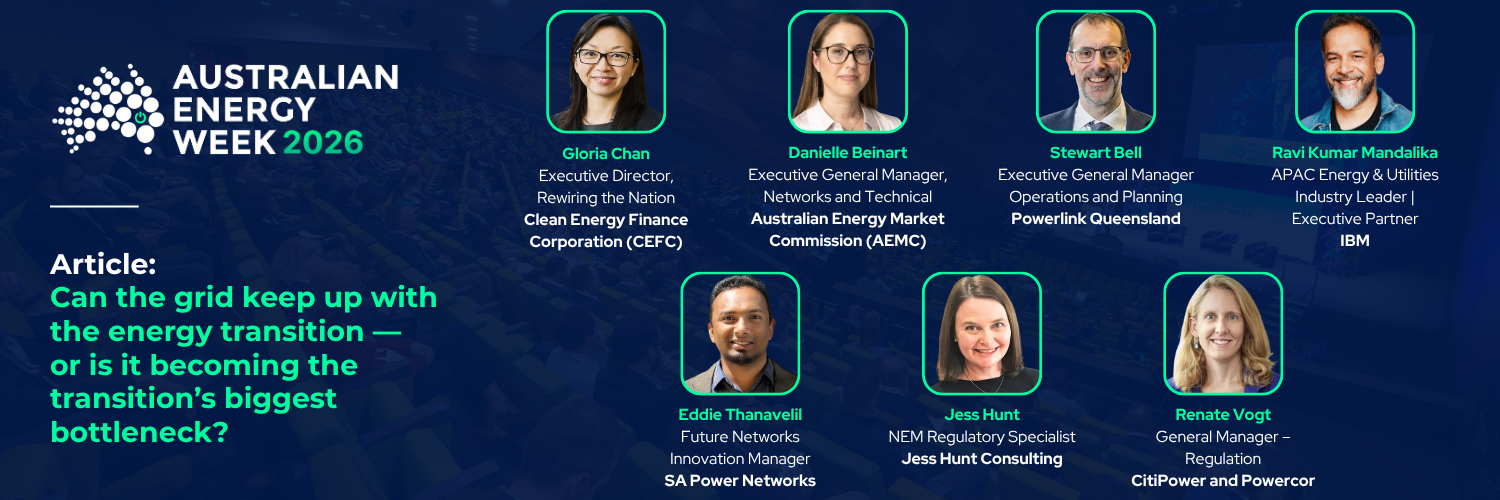
Join the conversation with Gloria Chan, Danielle Beinar, Stewart Bell, Renate Vogt, Eddie Thanavelil, Jess Hunt, Ravi Mandalika and a host of other energy experts at Australian Energy Week.
Download brochure