The transition isn’t stalling, it’s just getting harder to run
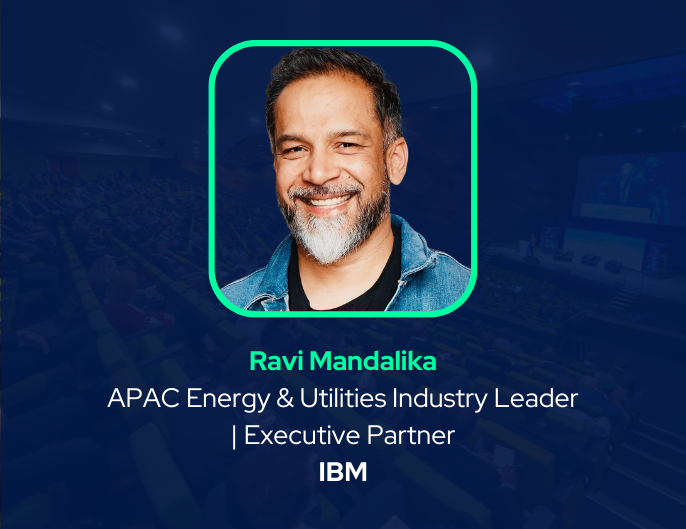
An interview with Ravi Mandalika, IBM
What is driving IBM’s approach to the transition?
IBM’s approach is driven by the reality that the energy transition is no longer a future strategy discussion. It is now an operational challenge. Utilities are trying to decarbonise while maintaining affordability, reliability, and security of supply, often on infrastructure that was never designed for this level of decentralisation and variability.
Our focus has been on helping clients modernise the operational core of the business. That includes grid operations, asset management, workforce enablement, forecasting, and planning. AI, automation, hybrid cloud, and digital engineering all play a role, but only when tied back to measurable operational outcomes.

“Technology alone does not drive transformation”
A big part of our perspective also comes from IBM’s own Client Zero journey. We applied many of these capabilities internally first. That experience reinforced an important lesson. Technology alone does not drive transformation. Success comes from aligning operations, data, workforce, and governance together.
How do you see the reality of 2030 targets aligning with current delivery pathways?
The ambition of the 2030 targets is still achievable, but the delivery pathway is becoming increasingly compressed and complex.
The challenge is no longer a lack of renewable generation ambition. Australia has a very strong pipeline across solar, wind, and storage. The pressure is now shifting toward transmission delivery, connection approvals, workforce availability, supply chains, and social licence.
What I think the industry underestimated was the scale of coordination required across the entire system. The transition is not simply replacing one form of generation with another. It is redesigning how the grid operates in real time.
““the pathway becomes more volatile, more expensive, and operationally harder than originally expected”
We are already seeing signs of strain through connection bottlenecks, curtailment, and growing congestion in parts of the NEM. That does not mean the targets fail, but it does mean the pathway becomes more volatile, more expensive, and operationally harder than originally expected.
How might the transition create different outcomes for regions, technologies and customer classes?
The transition will not play out evenly. Different regions and customer groups will experience it very differently.
Regions with strong transmission access, Renewable Energy Zones, and investment certainty are likely to accelerate faster and attract more capital. Other areas may experience slower development or increasing reliability pressure if network investment does not keep pace.
The same applies across technologies. Utility-scale renewables, batteries, distributed energy resources, and flexible demand all mature at different speeds and place different pressures on the grid.
Customers will also experience the transition differently. Large industrial users and data centres are increasingly becoming active participants in energy markets because of their scale and flexibility requirements. Residential customers are seeing greater choice through rooftop solar, batteries, and EVs, but also greater complexity around tariffs, orchestration, and reliability expectations.
One of the biggest risks is that the transition unintentionally creates uneven outcomes between those who can actively participate in the new energy system and those who cannot.
What are some common misconceptions about the transition, and how do they compare with reality?
One misconception is that the transition is mainly a generation challenge. In reality, the hardest part is increasingly the grid itself. Transmission, connections, system strength, market coordination, and operational complexity are becoming the defining issues.
Another misconception is that technology is the primary barrier. Most of the required technology already exists. The bigger challenge is execution at scale. Planning approvals, workforce capability, supply chains, regulatory coordination, and operational readiness are now the real constraints.
The transition is not being held back by ambition. It is being tested by complexity.
What about the transition keeps you up at night?
What concerns me most is the growing gap between the speed of investment and the system’s ability to operationalise it.
We are connecting more variable generation, more distributed energy resources, and larger new loads into a grid that is becoming more dynamic and harder to manage. At the same time, experienced operational workforce capability across the sector is tightening.
“the transition risks becoming slower, more expensive, and less equitable than it needs to be”
The risk is not a single catastrophic failure. It is the gradual accumulation of operational complexity across planning, coordination, connections, and real-time system management.
If we do not modernise how the grid is planned and operated, the transition risks becoming slower, more expensive, and less equitable than it needs to be.
Download brochure